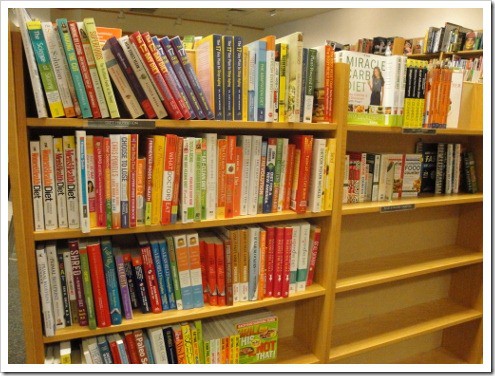
Walking into the “diet/nutrition” section of a bookstore is overwhelming, the sheer quantity and variety of books absolutely staggering.
I wandered into that section in a bookstore last week and started scanning titles. Almost immediately I began thinking about how many different diets one could embark on and how crazy it was that there were six full shelves of books JUST on diet and nutrition:
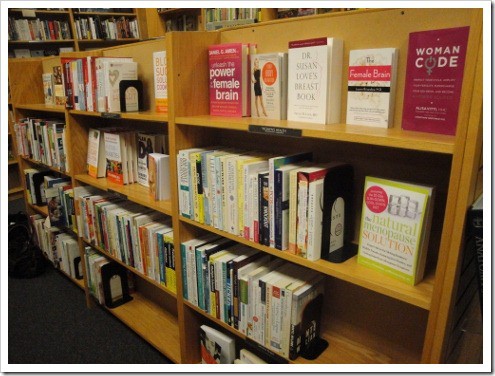
Not to mention the entire bookcase, three columns wide, behind me that addressed ill health: cancer, heart disease, diabetes, as well as allergy-free cooking and coping.
RELATED: 4 Ways to Prevent Type 2 Diabetes
Then I turned the corner and found 15 more shelves of diet books.
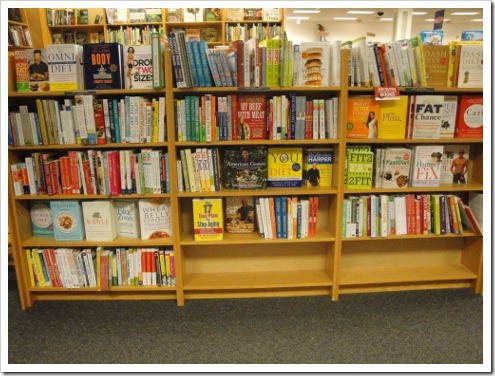
Everything from Paleo to vegetarian, from “eat more,” to “eat less;” eat the right fat, eat no fat; low sodium, low fat, low calorie, low everything else; eat to get smart, eat to avoid cancer, eat to feel great, eat to look sexy; avoid aging, avoid disease, avoid dieting; listen to your body; break your body’s habits, train your body, control your body; listen to the fireman, listen to the doctor, listen to the chef, listen to the medical association, listen to the fat guy, listen to the first lady, listen to the pop magazine; cut carbs, cut sugar, cut exercise; balance your hormones, balance your pH, balance your metabolism; diet like the Mediterranean, like the French, like the cavemen, like the Aztecs, or even like the Dukan, whoever they are; do a cleanse, get happy, get thin, get a flat belly; get a miracle, do it fast, do it for life.
Wow.
How anyone ever decides what to eat is baffling!
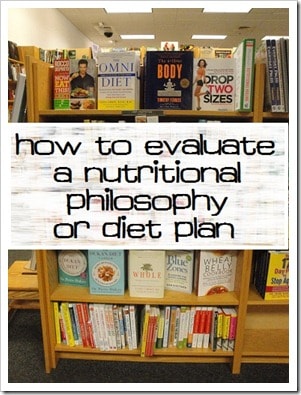
Whether you’re in a bookstore, reading the news, watching television or just browsing online, you are presented with a myriad of suggestions, some more forceful than others, about what you should eat to be healthy, to be thin, to be nourished. How does one evaluate the validity of all these claims?
Since many are at opposing ends of the same subject – Paleo vs. plant-based diets, for example, or pH balancing vs. the Weston A. Price Foundation’s perspective – they can’t all be right. At least not right for everyone. And some of them – I’m hoping more likely the “Get flat abs in 9 days!” and the “Miracle diet to get you sexy NOW!” type stuff – simply have to be wrong, dead wrong.
Today’s post was originally intended to be part of “common sense week (Link no longer available),” but I don’t always quite have enough common sense about time to realize what is possible to squeeze in 24 hours. 😉 Luckily, common sense should never go out of fashion.
A New Diet? A New Fad? Or a Lifestyle Recommendation?
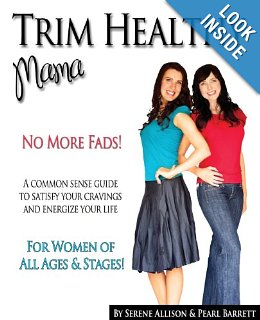 Perhaps you’ve noticed the buzz about the new-ish book, Trim Healthy Mama. I feel like it’s suddenly everywhere (except in that bookstore, where I had hoped to browse it for myself).
I am going to lead off by saying that I have NOT read the book at all, only others’ Trim Healthy Mama reviews (link no longer available) and explanations. Please don’t read this post as a description of the book, a review of the diet (lifestyle), or even a knowledgeable critique of Trim Healthy Mama.
I’m going to attempt to share with you my thinking as I evaluate a new idea in nutrition and health, using Trim Healthy Mama – which I haven’t read, did I mention that? – as an example of steps to take before you read 500 pages of text or spend $35 to explore an idea.
Step One: Get an Overview
This may seem obvious, but you can’t evaluate something if you can’t at least understand it, more or less. If a diet or nutrition book you’re looking at won’t let any of its main ideas out of the covers, it often feels too secretive to me to be worthwhile.
In the case of Trim Healthy Mama, I did some reading and talking with friends who were trying the program.
My incredibly rudimentary knowledge of the THM program is as follows:
- Don’t mix carbs and fat – especially if you’re still working on losing some weight instead of maintaining.
- An “on plan” meal that is “carb” based – called an “E” meal for “Energizing” – can only have up to a teaspoon of fat.
- An “on plan” meal that has fat – called an “S” meal for “Satisfying” – has to have less than 10g of carbs. It looks a bit more like a Paleo meal of meat and veggies.
- “Fuel Pull” (FP) meals, often snacks, are neither high in fat or carbs, and are good for weight loss. Think fresh fruit, veggies with no dip, low-fat dairy or meat.
- Once you’re not doing weight loss anymore, you can have 20% of your meals as “Crossovers” mixing fat and carbs.
- You can get a really good idea of how you’d eat on the plan by perusing the Pins on the THM page.
Some points about the plan that people love:
- No foods are truly “off limits” because if you can’t have them in one kind of meal, you can just have them in the next.
- You don’t have to restrict amounts of food.
- It’s really, really working for a lot of people.
In order to avoid mixing carbs and fat, the authors recommend using a few less common ingredients:
- gluccomannan powder
- peanut flour
- stevia– white powder extract
- Dreamfield’s pasta
- protein powder
And finally, even though the plan itself says that foods aren’t really off limits, it sounds like if you want to lose weight, the following are not “on plan:”
- grapes
- milk
- white potatoes
- white flour
- white rice
- sugars
- large amounts of corn
The plan also is lauded for not having to make special meals for those not on the plan, like your children…except that kids can and should have maple syrup and honey, according to the book, as well as more combination meals and snacks than adults. So it doesn’t really end up working out with everyone eating the same stuff all the time.
Note: See the comments for examples from people using THM demonstrating how they easily accomplish the “differences” between children’s and adults’ nutritional needs.
Step Two: Ask Lots of Questions
I feel very comfortable with a traditional foods philosophy. It resonates well with me that we should be eating foods that are grown the way God designed them to grow, are prepared in ways that don’t chemically alter the food into a lab experiment, and in amounts that make sense.
I like to eat foods that have been eaten by humans for hundreds of years or more, and I stay away from recent inventions (in the food world, that is). I try to consider how humans would have grown/harvested/prepared food before things like electricity came along.
I don’t always do everything exactly traditionally. For example, I’ll still smash the heck out of frozen bananas to make faux “ice cream” with my Blendtec, which is clearly not a traditional preparation, but I will consider that at least bananas are a whole food. It’s a balancing act.
Some questions I would ask when flipping through a new diet/nutrition book include:
- Is there anything that feels intuitively wrong or “off” to me?
- Would people have been able to do this long ago?
- Does the theory include processed foods?
- Would the plan be sustainable for you?
- Does the theory demand (or tempt you to use) the same food all the time? (since I wonder about How Much is Too Much? sometimes)
- Is there a hidden component that may cause success in spite of the main point?
Step Three: Get Some Answers
It deserves to be said again that I have not read the 600-page Trim Healthy Mama book, but I’ll demonstrate for you some of my initial thinking about it.
I started looking into the philosophy after people asked me about it or praised it at least three times in one week. It definitely caught my interest and begged some attention.
When you’re evaluating a nutritional philosophy, read everything you can. Read reviews on Amazon if it’s a book, read bloggers who follow this plan, read any applicable studies if there are any.
Once you understand the basics, you can ask questions about certain ingredients or methods and Swagbucks search your way to some information. I’ve spent far too long looking into the THM plan (hours and hours, ugh), but it kind of fascinates me, and I am uber-thorough whenever I start looking into something.
Here are some of the issues I evaluated:
It Feels Off: Stevia
Many people start with question number one and pause at the use of white stevia powder, which is kind of the only way to have a semi-sweet “treat” on plan which includes any fat, since you can’t mix fat and carbs. Stevia is in a lot of the Trim Healthy Mama recipes and is definitely recommended.
Some traditional foods folks don’t like the idea of stevia at all. They think it’s not real food, and some have heard that it causes infertility. But consider: South American cultures have used it for over a thousand years, and they’re still procreating…also, Nourishing Traditions says green peas will prevent pregnancies, but I never withhold those from my kids.
I think stevia is fine to use, BUT the liquid is clearly less processed than the white powder. I’d put well-made liquid stevia, and definitely the green leaf stevia, firmly in the “real food” category. I could make it at home, and it’s been used for centuries or more in other countries.
However, white powder stevia, although my husband uses it daily in his yogurt, is a stretch on the real food scale. A big one. It has to be made in a lab, and I don’t think there are a lot of long-term studies done on consistent, daily use of powdered stevia. I’ll let my kids have some liquid stevia at times – I don’t treat it like artificial sweeteners, which are poison – but I wouldn’t serve it to them every day. I have no particular reason for that, just a hesitancy.
I’m disappointed that the Trim Healthy Mama plan recommends white powder stevia, and even more disappointed that they include Truvia anywhere near the “okay” list, since Truvia, a brand associated with PepsiCo or CocaCola (I don’t really care which), is mostly erythritol, corn byproducts, and a little stevia. I think all of this is a deviation from “strict whole foods” which at least one of the authors claims to follow.
The use of stevia and the non-combining foods rule means that even though there supposedly “aren’t any foods you can’t eat,” there are plenty of foods and recipes you have to alter, like when Stacy made the chocomole from Healthy Snacks to Go – that one was easy to make into a Trim Healthy Mama legal recipe (link no longer available), but many of your favorite baking recipes would be out the window.
I don’t throw the book out the window yet…but I pause.
Traditional?
The question, “Would people have been able to do this long ago?” is tough to answer.
They COULD have…stevia is traditional, and anyone can eat meat and veggies without carbs and then carbs without fat…but I don’t know that it’s a very intuitive system, something that people would have stumbled across because they felt better when they did it (like perhaps avoiding eating grains raw, for example, or figuring out how to soak dry beans to make them both edible and digestible).
On the other hand, I have to ask the Devil’s advocate question: Did traditional peoples have any need to lose weight?
Probably not.
Their systems weren’t messed up by an overconsuming culture that has dumbed down our sense of satiety and our relationship with food so much so that most guts in America are probably out of balance and damaged. They had no need for weight loss or healing diets, so in some sense, it’s not a fair question.
Processed foods vs. whole foods
I already mentioned I’m not a huge fan of the stevia, and I’m really not sure about the protein powder they advocate. That said, I understand there’s a lot of research in the book, and I haven’t looked into the protein powder any more, so I can’t pass judgment. My husband likes to make protein drinks with whole foods protein powder and raw milk, too, so no stones thrown here.
However, a number of the foods the authors recommend to make “on plan” meals end up being highly processed. You all know me well enough by now that anytime some name brand food is recommended (required?), especially when that food is “new and improved,” I’m going to be the biggest skeptic in the house.
UPDATE: I’m not trying to throw the whole THM plan under the bus here, although the post has been interpreted that way. I think if you’re going to try THM, you should evaluate some of the parts as I do here. The GREAT part about the plan is that no one has to use any of the pieces I’m taking issue with.
A hard core Weston A. Price member could easily adapt the way they currently eat to follow the THM plan without adjusting their core nutritional principles. That’s awesome. Thanks to some commenters who were very generous with their time and knowledge to help us all understand that the processed foods are definitely NOT required, just an option for those who are not ready for a whole foods transformation.
dreamfields pasta
 When I saw that the authors of THM recommended a special pasta with carbs that don’t digest…imagine me shaking my head and beginning the Swagbucks search for Dreamfields pasta.
Let’s look at the ingredients:
This is not whole foods. Synthetic vitamins enriching white flour, xanthan gum is debatable on safety, inulin must be the insoluble fiber that somehow magically makes the other carbs pass through, and added gluten…don’t get me started. Not an auspicious start.
Now let’s tackle the manufacturer’s claims that this product is low glycemic, with 31 grams of carbs that can’t be digested.
First, do we really want to be eating things that aren’t digestible…on purpose? Particularly things that are man-made to be indigestible. It seems better to NOT put something through your intestines that will just shoot through. What else might it be doing as it’s not being digested in there? I don’t know the answer, but that question makes me really stop and think.
Second, is it really low glycemic? There are a handful of dissenters in the reviews at Amazon who have taken their own blood sugar and gotten incredibly high numbers after eating Dreamfields or noticed bloating like they have with any other grain. There are others who disagree, so it’s possible that it reacts differently with different people…but like one commenter said, I wouldn’t share this pasta with a diabetic family member.
I saw Dr. Oz do a questionable segment on indigestible carbs, called resistant starch. The idea was that you don’t digest the carbs in certain fancy flours, green bananas, and pasta cooked al dente. Dr. Oz recommended cooking all pasta a few minutes less than the recommended cooking time so that your body didn’t digest it. (And how do we feel about that?)
Guess how Dreamfields pasta must be cooked? Quite al dente, or it turns to mush. Perhaps the low-carbers spending over $3/box would be better served with cheap pasta cooked for 5 minutes.
Finally, what does the research say? The manufacturer’s studies and claims don’t hold up well against this online doctor’s independent testing (fascinating blood sugar charts at that post), the product is questioned pretty seriously by a popular low carb dieting site, and in a genuine scientific study on Dreamfields, the results were abysmal and the glycemic index was high.
Although that study hasn’t been reproduced and shouldn’t be taken as gospel, it calls into question the marketing claims of this “new” food product. With that many questions, it’s not something I’d rely on for my good health and nothing I’d bother giving my kids.
One last note: (Remember that I haven’t read the book) A review on Amazon also picked on the use of this pasta, and some commenters there corrected the reviewer, saying that Dreamfields was just an extra option for those not willing to make their own noodles. The original commenter came back with this:
I love spaghetti squash, but it’s expensive most times of year. We only eat it in the fall. I have no idea what some of those others are, but I suppose if they’re vegetables, I can’t take issue with them…right?
low fat dairy
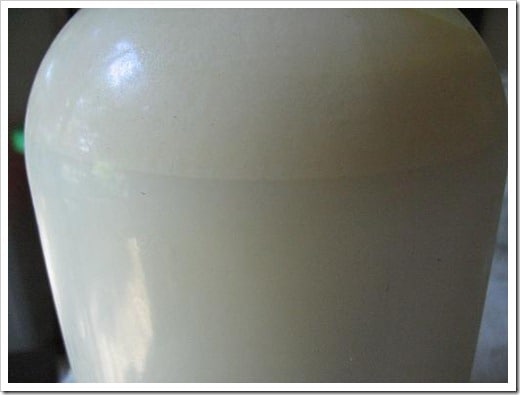
For “Fuel Pull” and also “E” meals, low fat dairy is a must (and drinking plain milk is out). This doesn’t resonate all that well with me either, since fat doesn’t make you fat, and I happen to buy into the whole fat dairy theory (see creamline, above).
In defense of the THM use of low-fat and fat-free dairy, people will say that it’s still a whole food: you can skim the cream off your milk, drink the skim milk in one meal and use the cream at a different meal, and it’s totally natural and traditional.
Which is true…if you’re a pig.
Traditionally, when farm families would skim the cream to sell or to make butter or ice cream, the skim milk would go to the pigs. Milk fed pigs, once fattened up, are delicious.
You’re all catching the irony, right?
So I don’t think using some fat free dairy is evil. I don’t think it’s anti-whole foods. But I do think it’s not traditional, and it’s just one more tick mark on the “maybe not for me” list about Trim Healthy Mama.
Silk brand almond milk
I just peeked at the THM Facebook page to see what the buzz was there, and I noticed that one of the authors uses and recommends Silk brand unsweetened almond milk.
Traditional food? Eh. You can make it at home, which is fine, but it still seems to start leaning toward the “too many nuts” issue that I find with the way some people eat Paleo.
The ingredients are a bit cleaner than I expected, but still not ideal:
VITAMINS & MINERALS: Calcium Carbonate, Vitamin E Acetate, Zinc Gluconate, Vitamin A Palmitate, Riboflavin (B2), Vitamin B12, Vitamin D2.
Synthetic vitamins and minerals? Eh. Gums and lecithin? Eh. I would miss my raw milk far too much…
Sustainable?
Every time I’ve described this plan briefly to a friend, their eyes get wide and they say, “That doesn’t sound like something I could keep up.” On the other hand, Stacy (link no longer available) says it’s an absolute lifestyle and something she and her husband will be able to sustain forever.
Perhaps it’s easier once you’re used to it…the sustainability question is something each person needs to answer for themselves, but I will say this about Trim Healthy Mama: from what I understand, they offer a lot of grace on the “oops” days and the compromises, which I think goes miles toward keeping people trying instead of throwing in the towel.
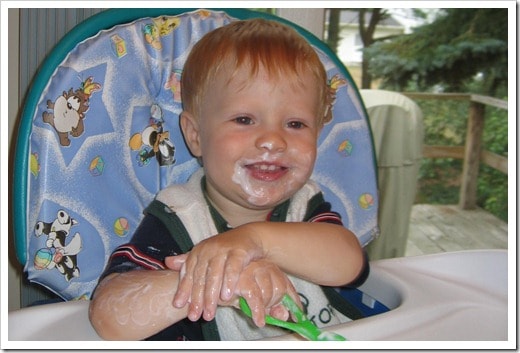
The plan also calls for different foods for kids. For example, kids can eat legumes, wheat, milk, and honey, but those on the weight-loss plan, at least as far as I understand, cannot. It sounds like the authors do buy foods that are only for their children, which quite frankly, would drive me nuts.
We eat as a family, and I don’t make separate meals for my kids, so to add that to my daily routine just doesn’t sound palatable.
I also take issue with wheat being more for children than adults. I understand that THM is largely about glycemic index, and that wheat can really mess people up on that scale. But there are a lot of arguments against wheat because of its hybridization, and I would say on that front that it’s even more dangerous for kids and their less-developed digestive systems. We kept wheat out of our youngest’s diet for 18 months, and at 22 months currently, he’s only had wheat a handful of times, always whole wheat and soaked. So many questions about that issue…
On the other hand, I do respect that the authors are taking care with children and viewing them differently. I’d hate to see parents on a “diet” (this is not supposed to be) who harm their kiddos by making them eat “diet food” that isn’t what their little bodies need. (Fat free milk, anyone?)
And on the third hand, because that’s how I’m feeling today, if Trim Healthy Mama isn’t a diet plan, why do kids have to eat differently? Perhaps it comes back to “did traditional people diet?” Is all our dieting, and the fact that perhaps we are supposed to eat things as kids and not adults, a result of our fallen world, carb-heavy society, and general bad food choices?
Comparing THM with the Paleo diet/lifestyle, I am sure there are plenty who would say that eating Paleo is not safe for children. I have a hunch the THM authors would be among them since they say kids need carbs for energy.
When Paleo eaters use a lot of almond or coconut flour to mimic baked goods, are they really eating as people did so long ago? Or is something like a Whole 30, where you’re not allowed to bake anything, no substitutes for the old unhealthy standbys, more realistically “Paleo?”
These are the questions I like to ask as I evaluate any system of eating or diet plan.
What Really Works?
What’s most astonishing about the Trim Healthy Mama plan is how quickly it has caught on and how many fervent proponents there are, people who are finding incredible success and really feel as if they’ll be able to sustain their weight loss.
In fact, many of them are probably already typing frustrated comments without getting this far down. I hope I haven’t judged too quickly – again, I’ll remind you, I haven’t read the book or tried the plan.
I have to ask one last question, though: Is it “The Plan” that really works for weight loss, or something else?
For example:
- Switching to a whole foods diet in general can have incredible impacts, and in order to eat “on plan” one really does need to eat a lot of whole foods, vegetables, and healthy, “clean” eating. If this is a new lifestyle for someone, that alone could cause weight loss, regardless of carb/fat balancing.
- Since many meals must be low carb, I’m guess that for most people, their diets overall are lower in carbs, therefore grains, than usual. Again, that alone can make a huge impact on weight and general health.
- With the combining rules, most people’s favorite baking recipes, as I mentioned above when I talked stevia, are out the window. If folks are eating fewer baked goods and sweets since it’s a lot of work to adjust old recipes or try new recipes, then they’re consuming fewer empty calories.
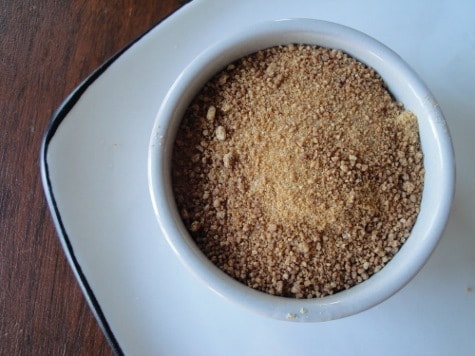
- No sweeteners? How many Americans, while dieting, have honestly cut all sweeteners? The first question I would ask someone who has a huge success with THM is, “Have you ever cut all sugars out of your diet before?”
- Although the plan says it doesn’t cut a lot of things, cutting all sugars and all white flour already is a huge step and would drastically change many Standard American Diets. Additionally cutting white potatoes and corn chops out a ton of normally eaten carbs and starches. That’s huge. I know some people have already tried Paleo or grain-free and it didn’t work for them, while THM did, but for many, cutting all that junk would be plenty of changes, both for feeling overwhelmed and for losing the weight effectively.
When you’re evaluating any new way of eating, ask yourself: How many parts of this are different from how I eat now? What is different for the people who are having success, and is it the new plan in its totality that is working for them, or is it one certain part of the plan – perhaps not its central tenet?
On Successes and Fads
At some level, one can’t argue with success. It’s incredible to read of the many people the Trim Healthy Mama plan has helped, whether in Amazon reviews, on blogs, and on the THM website or Facebook page.
On the other hand, I’m curious to see where this goes.
All sorts of diets have success stories (calm down, Stacy, I know THM isn’t a diet, but I have to use words everyone knows). I really respect that the authors did a ton of research, and who knows? Maybe they’re 100% right on the food combining front, and they should just stop allowing processed foods on their plan. Then again, maybe they’d lose half their customers if they didn’t.
If it’s a fad, it’ll peter out. People won’t be able to sustain it.
The authors themselves are bold enough to put the word “fad” right on the cover, claiming their plan is NOT a fad. Only time will tell, since by definition, a fad has to go in and out of style, right? 
How to Evaluate a Nutritional Philosophy
Since “diet” is such an ugly word for many people, let’s call our topic “nutritional philosophy,” shall we?
Since this post is not supposed to be all about Trim Healthy Mama, but rather an example of how you can evaluate whatever nutritional philosophy you come across, let’s review the basic steps:
- Get a rudimentary understanding of the plan/philosophy. Read about it wherever you can (as long as you find some sources not affiliated with those who stand to make a profit).
- Ask lots of thoughtful questions:
- Is there anything that feels intuitively wrong or “off” to me?
- Would people have been able to do this long ago?
- Does the theory include processed foods?
- Would the plan be sustainable for you?
- Does the theory demand (or tempt you to use) the same food all the time?
- Is there a hidden component that may cause success in spite of the main point?
- What is the background?
- Read Amazon reviews, and be sure to get into any comments on people’s reviews – that’s where conversation can really get going. Also, don’t believe the most laudatory or the most derogatory. Some people are just mean-spirited, and some are just wrong. (And authors can’t do much about those…I should know, since The Family Camping Handbook kind of got a meanie 1-star review. Some commenters did a nice job of setting the record straight, but I don’t know how many people click through to those.)
- Consider yourself. What do you think you would be able to sustain? Does it feel like a good fit for you? If you can try out the plan for a time, see how it feels, physically, emotionally, socially.
I remain pretty fascinated by the whole Trim Healthy Mama plan, and I probably should read the book at some point. For now, I just need to figure out what’s for breakfast tomorrow…and dinner…and lunch. You gotta eat!
What “lens” do you like to use to view various nutritional philosophies? How do you decide what’s right for you?
Disclosure: There are affiliate links in this post to Amazon from which I will earn some commission if you make a purchase. Swagbucks referrals also help me earn bucks. See my full disclosure statement here.
Thank you for this post. This is exactly the kind of info I was looking for!
Thank you for this. At sixty years old, I’ve been through at least three “food-combining” diets (including THM), and they ALL have mountains of research and they can ALL show how their way of eating is the most revolutionary, natural, and best.
And incidentally, I’ve got at least three relatives doing wonderfully on THM, and I had good results with it last spring, until I just couldn’t handle it as an everyday thing any longer.
I finally learned the same things as you — it’s best to actually investigate the claims in such diets (oh, pardon me, lifestyles) for yourself and not just follow the enthusiastic, often evangelistic crowd. How many people are currently following the “Fit for Life” diet plan, which was all the rage (and considered very godly and almost compulsory) in my church community in the nineties? But IT had “all the science” behind it too!
I do love many of the THM recipes, very much. But I think you are absolutely correct — it’s very likely that the real reason people are wonderfully losing weight and feeling so good is that they are eating whole foods, are eating less refined sugar, have cut out extensive wheat products, and, since THM recommends it so highly — doing more exercise. All of those things together will inevitably result in weight loss.
And not all of the “science” in the book is good. They recommend not eating much fruit (and they take a pointed swipe at Fit for Life by saying you should NOT eat fruit for breakfast) — their reason being that fruits contain sugars, and “sugar is sugar,” and so you shouldn’t have much. But in fact, “sugar is NOT sugar.” Refined sugar is bad, yes. But the glucose in fruit is NECESSARY for brain health. Cut that back, and you risk a LOT, with respect to your alertness, your ability to think, and even your brain’s ability to help your body in its physical functions. So — no. Eat the bloody fruit.
Anyway, I loved this excellent analysis. You demonstrated the WAY someone should think about and examine a diet’s claims, whether it’s THM, Fit for Life, Dr. Atkins, etc. etc. Thank you so much for this!
Thanks, Pat – I’ve never even heard of “Fit for Life” so that’s pretty funny to consider the comparison. 🙂 Katie
I realize the original post is over 2 years old, but out of curiosity I’m wondering if all the THM followers are still “on plan” and losing weight or have kept their weight off.
Olivia,
You should check out Wardee’s story at http://traditionalcookingschool.com/ – great success! 🙂 Katie
I looked into the THM diet with the intent if starting it right away. But the book was so long that it left me more confused than hopeful. If it takes that long to describe their eating plan, then it may just be too complex and in reality, not very “common sense” at all. If it was “common” it wouldn’t take 600 pages to explain it. The first place I lost respect for the book was where they said their diet plan is the ONLY way to lose weight Nd keep it off. That is a false statement to cause dependency on one plan that makes people afraid to try any others. Not every diet plan is for everybody. I still hold to the old fashioned calories in should be less than calories out to lose weight or equal to maintain weight. The next place that the book frustrated me was when they talked the foods in the Bible and then mentioned staying away from those same foods. I believe the Bible teaches all things in moderation. At this point I did not finish the book. What I had read so far was leaving me feeling more and more discouraged. Yet I take one more issue with the diet plan. When you hear people talk about their weight loss, it is in extreme amounts! Healthy weight loss should be slow and steady. Huge amounts of weight dropped in short periods of time bring the word “fad” to my mind. So that is my two cents from the part that I did read.
I was following Eat To Live before starting THM.I really loved THM and the great foods I got to eat. However my health did not improve with this plan. My chest pains and shortness of breath came back with a vengeance and became worse. My breathing was labored and difficult. I would just cry because it was so hard to catch my breath. I reluctantly went back onto Eat to Live and my problems started to subside. I’d say I’ve had at least 85% if not more reduction in symptoms. I felt more in bondage to food during my THM time too – I thought about food a lot. Now I eat 3 times a day and thoughts are not totally consumed with food. I’m glad THM works for some people but for those of us who may have more health issues a more radical approach may be what is best. I think the key to any plan is to find recipes you like and are willing to eat. I eat for health and nutrition now – that is my sole focus. Losing weight has been the result and feeling so much better.
I have not read the book either, but from what you and the ladies in the comments describe, this “diet” is pretty much what Suzanne Somers’ diet books were all about except that she started out having more of a whole foods approach and then all sorts of funky foods (think sweet syrups etc.) started making their way to being acceptable since they made the carb only meals palatable. I think it was about 8 years ago or so that I followed her plan and lost about 25 lbs. Then I quit following it and started eating normally again and gained it all back plus more. Just like every other diet I’ve followed (3 day diet first, then Suzanne Somers, then Atkins, then WAPF with a very low carb leaning – sort of primal but not adhering to the paleo/primal guidelines, just not eating much bread unless I “cheated” or fruit/sugar/sweet things. And then I usually binged cause I couldn’t control myself.
Carb only meals are really hard to keep up. They don’t taste good since fat makes food taste good. So I think many people end up eating low carb even though they don’t really mean to. And then they lose tons of weight. But carbs with fat taste good. And everybody else eats them, so you either avoid social gatherings, or run the risk of “cheating”.
I have just been reading about metabolism from Matt Stone. He can be crude and rude, but he has been around the block with “diets” including WAPF and what he says makes so much sense to me – and I feel that God is blessing me through this messenger 🙂
Anyway, tracking my temperature has shown me that my metabolism has been low (Matt says we should have a waking temp of no lower than 98.0 and up to 99.0 would show a very strong metabolism. I’ve only be following his recommendations (eating lots of starch, sugar & salt as well as healthy fats and not drinking except when thirsty and trying to get between 8 to 10 hours of sleep, which hasn’t happened without naps yet, but I’m doing better 🙂
I believe my metabolism has been low for a very long time based on my dry skin/excema which is now pretty much cleared up after only 2 weeks eating this way, my waking temps have gone from around low 97’s to 98.0-98.3 consistently the past few days, my hair feels softer and isn’t breaking as much and my moods. Oh, my moods are SO. MUCH. BETTER!! I have gained weight, but that is expected and I already feel more strength in my body and am starting to have the energy I’ll need to actually exercise (with an emphasis on strength, not cardio) in order to lose the pounds that have come on.
Anyway, that went off track, but my main point is that I’ve done something very similar to what this book sounds like it’s recommending and couldn’t make it a lifestyle and now I’ve come full circle and am working my way back to balance. In a very non-conventional way 🙂
Blessings,
Lisa V in BC
I’ve lost 35 with the plan and a total of 50 since last Christmas. This is the first time I have ever been able to do it.
I thank God for giving me a way to lose the weight that is so flexible.
I don’t have to do it 100% of the time. I can make the changes I want to without bondage.
I’m breaking every chain through Jesus Christ and healthier choices.
Laura Lane
How very disappointing to read this sortof article here. If you haven’t read the book, then I don’t see how you can understand the way that the information is presented. It is written by two sisters, one who is VERY MUCH a real food purist, and a sister who is more laid back on food matters.
I followed a whole foods, organic, Weston A Price lifestyle for 8 years before I found Trim Healthy Mama. I gained FORTY POUNDS living that lifestyle. Does that happen to everyone? No. But for me WAPF was only making me depressed, overweight, and obsessed with everything put in my mouth. I started THM in January of 2013 and once I got a hang of the way to do it, I found myself eating FREELY of every food group, eating a much more varied diet full of fruits, vegetables, healthy fats, ferments, and whole grains where appropriate. I lost FORTY POUNDS. Now let me tell you, I know that no eating plan is guaranteed to be the answer for everyone. Even the authors acknowledge that in the book.
I have held such enormous regard for you with the many things you cover on your blog, but reading an article which is so negative about something you repeatedly say you have no first hand experience with, nor have you read the book, disappoints me greatly. I wish you well, but I would ask you kindly to reconsider keeping this article until you have had a chance to honestly consider the information found in the book.
Articles like this have the potential to ruin the business and ministry of two kind, well intentioned, and I would contend, well researched ladies who have brought hope and healthy weight loss to thousands of women, myself included.
Kristen,
I’m really glad you had such success with THM; what a joy! I’m sorry my post felt so negative, but it is intended to help people explore a nutritional philosophy specifically without reading it all, since no one has time to read every diet book on the market. The post has been up since June and I don’t think it’s hurt Pearl and Serene’s ministry at all, but I do stand by what I posted.
Thanks, Katie