
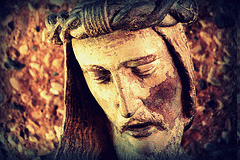
 Why sacrifice? Why suffer on purpose?
During the season of Lent, Catholics and many others choose to accept suffering, even bring it on themselves through voluntary sacrifice called fasting. To the outside observer, it may seem meaningless, even a bit insane to call suffering a form of prayer.
I couldn’t disagree more.
I’ve mentioned before that I count on Lent to help me clean up areas of my prayer life that have gotten sloppy, and the discipline of sacrifice is a major part of that. Discipline is a key word there, coming from the root meaning “to teach”. We have much to learn from suffering.
Reminder to Pray
A simple explanation of why one might want to fast is that it’s a reminder to actively pray, just like you might set an alarm or a calendar pop-up on your computer to remind you to attend a meeting or complete a certain task. When I am presented with the opportunity to abstain from the thing which I’ve chosen to “give up” for Lent, I can use that to inspire me to pray.
For example, my husband went to a conference for work last Saturday. He had to get up at 5:00 a.m. – on a weekend! – drive three hours, and spend all day with his co-workers listening to people talk. He gave up soda pop for Lent, and when he got home, one of the first things he said was, “I had lots of opportunities to pray today!” Between meals out, free drinks during workshops, and being incredibly tired, he was tempted with and yearning for his pop all day long.
In 1 Thessalonians 5:17, St. Paul tells us to “pray without ceasing.” For those of us who are not cloistered nuns, this is an impossible task to complete, unless there are forms of prayer other than hitting one’s knees and praying actively in words. In order to pray every second of the day, prayer has to be an action. What action could be so holy as to be called a prayer just by doing it?
Uniting Your Suffering to Christ
We know that by Christ’s suffering at Calvary, we are saved. By His voluntary participation (Matt. 26:39) in the sacrifice of the Cross, He made atonement for our sins and opened the gates of Heaven. We also know we are called to “be perfect as your Heavenly Father is perfect” (Matt. 5:28) and to imitate Christ insofar as the grace we have been granted allows. Should we not also imitate His acceptance of suffering?
Christ validated and gave meaning to suffering by shedding His Blood for the ultimate goal. By washing away our sins with His Blood, He not only conquered death, but reclaimed suffering from the devil. We are remiss when we do not participate in this amazing grace…of suffering.
I offer you two verses that shed much light on this issue:
“He supports us in every hardship, so that we are able to come to the support of others, in every hardship of theirs because of the encouragement that we ourselves receive from God. For just as the sufferings of Christ overflow into our lives; so too does the encouragement we receive through Christ.” (2 Cor. 1:4-5)
What is lacking in Christ’s afflictions… What?!? Did you catch that? Is St. Paul claiming that Christ didn’t do enough? That He needs help finishing the job of salvation? Certainly not; that explanation doesn’t fit with what we know of the person of Christ and the salvation that has been won, once and for all, by His death.
So what is lacking?
We are.
Just as a perfectly constructed baseball stadium, museum, or church is incomplete without the players and fans, works of art, or congregation, the Head of the Church is not complete without the participation of the Body, the Vine has no one to share with without the branches.
God doesn’t need us to be whole or to be perfect. The Trinity is already perfect and fulfilled. The Church, however, does need us to participate in Christ’s calling in order to be a Church. Christ chooses to require our participation, even in His suffering.
Why?
So that we are able to come to the support of others… As we find support in our own suffering, we are able to share that encouragement when others are having difficult times.
Better yet, we are also able to unite our sufferings to Christ as a sign of solidarity and as an offering of prayer. As we accept suffering and offer small sacrifices in our own lives, Christ can use that sacrifice literally as a prayer to enact good in the world.
Your fast from desserts, offered willingly, could be a powerful prayer for the salvation of the soul of someone across the world. By swallowing your pride to complete simple daily duties like sweeping the floor, you might participate in a peaceful meeting in the Middle East. You can also choose to offer up the suffering that comes to you, such as an illness, difficulty with a neighbor, or challenging child. Transform what seems like an awful situation into an opportunity for prayer. God can use your tiny offering, your subjection of your will, united with Christ’s suffering, to change the world.
Become Master of Your Will
There is yet another value to the practice of fasting and voluntary sacrifice. In our world today, we are bombarded by temptations to our consciences. We are asked by advertising to spend more, consume more, reveal more and fantasize more. We are told to assert our wills and be masters of our own domain, tricked into thinking we really are in charge as we bow to the gods of the media.
More than ever, we need to practice the habit of self-discipline. Opportunities to do so are slim unless you create them for yourself. Choosing to fast from something, whether food, bad habit, or lazy pastime, helps you learn to resist temptation and be master of your desires. For example, if I want chocolate, and I deny my craving successfully, then I am that much stronger when other temptations come my way.
Self-discipline is necessary no matter what your state in life. It is a rare person who can spend as much money as they want; most of us need to be disciplined in our finances. If you are married, you need the discipline to keep your eyes and mind on your spouse alone, not the onslaught of images that hit you every day. Self-denial is a key ingredient to having a lasting marriage. Parents need more self-discipline than anyone, having to constantly subject their wants and needs for those of their children.
Fasting, sacrifice and suffering allow you to practice denial and form your habit of self-discipline, while also improving your personal prayer life and allowing you to participate in the life-changing sacrifice of the Cross. They also remind us that this world is not our home, and we yearn for something greater. In spite of all the suffering in the world, we are called to hope:
–Pope Benedict XVI, Spe Salvi
May we offer up our suffering, both chosen and of circumstance, with all our will, for the intentions of the Holy Father and the good of our families today.
How are your Lenten devotions going? How do you consciously offer up sacrifices to the Lord?
Photo from akahodag
Linked. Thanks! :>)
.-= Lenetta @ Nettacow´s last blog ..How To Wash a Toddler’s Hands =-.
This is a hard subject to explain to denominations and religions that do not ‘seek’ suffering and sacrifice. You have done a wonderful job explaining it and also given me a few things to think about myself 🙂
I just found your blog this week. What a beautiful discussion of redemptive suffering. I always pray I can put such topics in a hands-on manner when asked. Thanks for the lenten blessing (& motivation)!
Heidi,
Welcome aboard! Glad all this made sense to you. 😉 Katie
Absolutely wonderful. What a beautiful reminder for me tonight. Thank you! I love your blog and ALL of your posts!
I’ve got a question for you. It’s a thought I’ve been pondering lately.
What truly constitutes “prayer?” Do we need to be completely devoted to the praying? That is, do we need to, either alone or as a group, sit down, clear our minds fully, and speak directly to God with absolutely no distractions?
Or, is it possible that while we are busy with our daily lives, pondering God and His will and considering what He would have us do and what He might do next is also prayer? If we are thinking of God, are we, in a sense, praying? Do we have to be wholly focused on Him or is it enough, sometimes, that He is at the center of the rest of the “stuff” we have to do?
I like to think that even if I don’t have enough moments to sit down and say a “real” prayer, that God is still listening when I am considering Him and trying to live for Him. What do you think?
.-= Kate´s last blog ..Thoughts on Children =-.
Kate,
Well said, I think. Going out on a date with your husband isn’t always face to face talking and only that; there are many ways to be with a human person, and prayer should simply be practicing the presence of God, to borrow a phrase. My thoughts on the subject here: http://staging.kitchenstewardship.com/2009/03/01/mary-and-martha-capturing-kitchen-prayer-moments/
I wish I was better at devoted prayer, to be honest, but I settle for busy prayer for this stage in my life.
🙂 Katie
Wow!! I am a Christian and yet misunderstood the the Catholic reason for Lent……..how naive I WAS!! Thank you for sharing the beauty of Lent. I will patiently wait for next year.
Thank you,
Kelley
Very nice piece. I’m not a Christian, but I was raised that way, and the idea of conscientious suffering is one that I have kept. I think our society is far to focused on avoidance of suffering and ignore all that suffering can teach. Life is pain and our job while alive is not to eradicate pain in our life but to learn from the pain and help others through their pain. I’ve suffered some serious pain in my life, but would not change any of it. It’s made me who I am.